Daat Emet
  • Torah, Science & Ethics
    • Pamphlets
    • Scientific Errors in Torah
    • Religion & Ethics
    • Mitzvahs
    • Religion Caught in Its Own Net
  • Torah & Talmud
    • Weekly Portion
    • Torah Text
    • Talmud Issues
    • Daily Peppers
  • Questions & Answers
  • Who We Are
    • About Daat Emet
    • Our Supporters
    • Support Us
  • English
    • עברית (Hebrew)
    • Русский (Russian)
    • Yiddish
    • Français (French)
  • Torah, Science & Ethics
    • Pamphlets
    • Scientific Errors in Torah
    • Religion & Ethics
    • Mitzvahs
    • Religion Caught in Its Own Net
  • Torah & Talmud
    • Weekly Portion
    • Torah Text
    • Talmud Issues
    • Daily Peppers
  • Questions & Answers
  • Who We Are
    • About Daat Emet
    • Our Supporters
    • Support Us
  • English
    • עברית (Hebrew)
    • Русский (Russian)
    • Yiddish
    • Français (French)
Daat Emet
  • Torah, Science & Ethics
    • Pamphlets
    • Scientific Errors in Torah
    • Religion & Ethics
    • Mitzvahs
    • Religion Caught in Its Own Net
  • Torah & Talmud
    • Weekly Portion
    • Torah Text
    • Talmud Issues
    • Daily Peppers
  • Questions & Answers
  • Who We Are
    • About Daat Emet
    • Our Supporters
    • Support Us
  • English
    • עברית (Hebrew)
    • Русский (Russian)
    • Yiddish
    • Français (French)
  • Torah, Science & Ethics
    • Pamphlets
    • Scientific Errors in Torah
    • Religion & Ethics
    • Mitzvahs
    • Religion Caught in Its Own Net
  • Torah & Talmud
    • Weekly Portion
    • Torah Text
    • Talmud Issues
    • Daily Peppers
  • Questions & Answers
  • Who We Are
    • About Daat Emet
    • Our Supporters
    • Support Us
  • English
    • עברית (Hebrew)
    • Русский (Russian)
    • Yiddish
    • Français (French)
One who weds a woman with the excrement of a bull under a sentence of death
Home » Daily Peppers
Yaron Yadan 05/02/2010
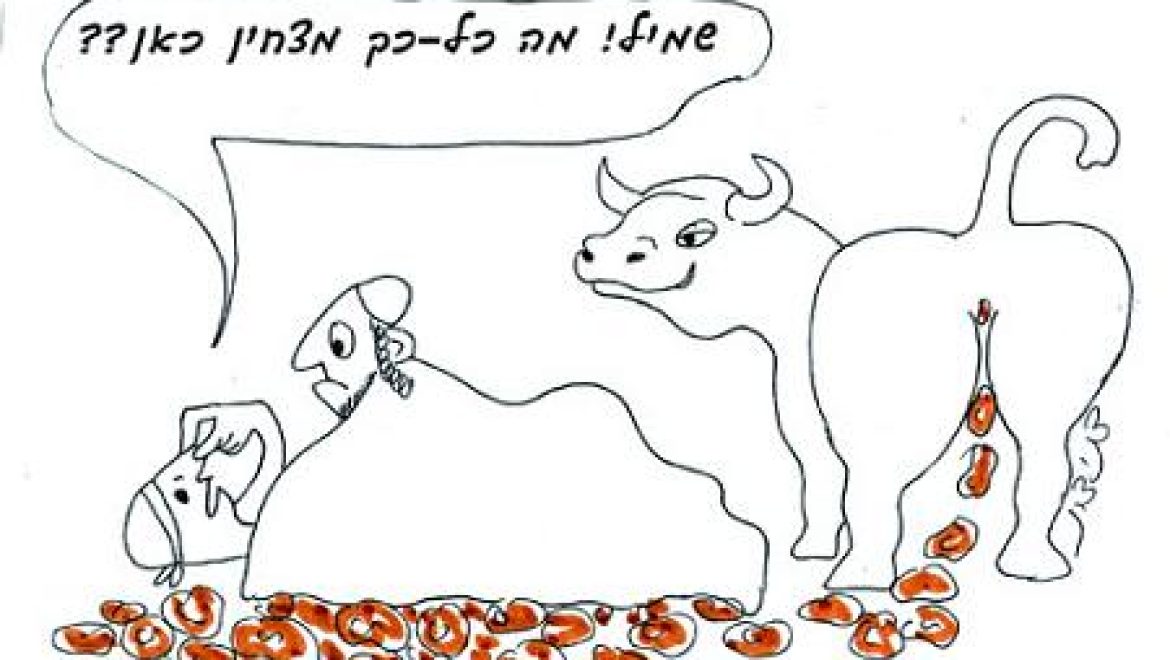
One who weds a woman with the excrement of a bull under a sentence of death

According to Halacha, one of the ways in which a man can acquire a woman as his wife is monetary. The man must give the woman the equivalent of no less than a perutah (worth about 10 Israeli agurot c. 2007). Chazal discussed at great length the value of the perutah. Thus, for example, one of the discussions revolved around a man who wed a woman with the excrement of a bull who had been found liable to death and whose flesh one is forbidden to have benefit from. Is the marriage valid? What are the issues under debate? Is the excrement of a bull from whom one is forbidden to derive benefit included in the prohibition against benefit, and so its monetary value is less than a perutah? One of the scholars draws a distinction between one bull and another, between the excrement of a bull which has been used in idolatrous practices, whose excrement would not contract a valid marriage, and the excrement of a bull which gored a person and killed him, but which could be used to contract a valid marriage. The reason for the distinction is the implication of what is written in the Scriptures and also deduction. A bull which has been used for idolatrous practices must be burned and killed, according to Torah law, and no benefit may be derived from it, for it is written “So none of the accursed things shall remain in your hand” (Deuteronomy 13:17). Since it is written “none” it means that everything is forbidden, even the excrement. It is also to be deduced that the excrement of a bull meant for idolatrous practices is forbidden for use and enjoyment because as long as the excrement remains in the digestive system it bloats the bull’s belly, making him appear larger and better, worthy of sacrifice in an idolatrous ritual, so the excrement is forbidden for use. Therefore the excrement has no monetary value for sanctifying a woman in marriage. On the other hand, a bull which gored and killed a person must be killed according to Torah law, and one may not derive benefit from its flesh, for it is written: “If an ox gores a man or a woman to death, then the ox shall surely be stoned, and its flesh shall not be eaten” (Exodus 21:28). Because it is written “its flesh shall not be eaten” we learn that its flesh is forbidden, but its excrement is permitted. We deduce that the owner of the bull which gored a person does not want its excrement to remain in its belly and does not want to see the bull looking large and handsome, so its excrement is not included in the prohibition against benefit; it is permitted for use. Therefore this excrement has monetary value which permits its use in contracting a marriage.

About the Author

ירון ידען View all posts by Yaron Yadan

ירון ידען (נולד בטבריה ב-8 בדצמבר 1961) הוא פעיל חברתי ומייסד ארגון "דעת אמת" העומד בראש מפלגת אור.

Additional Peppers
Is one permitted to rejoice at the fall of evil-doers? Who were the harlots who washed in Ahab

Is one permitted to rejoice at the fall of evil-doers? Who were the harlots who washed in Ahab

Rain water formed from ocean waters may be carried on holidays

Rain water formed from ocean waters may be carried on holidays

Is one permitted to urinate while wearing tefillin?

Is one permitted to urinate while wearing tefillin?

A dog who runs after a woman

A dog who runs after a woman

One who has erectile dysfunction should boil safflower in wine and drink it

One who has erectile dysfunction should boil safflower in wine and drink it

How can you tell if a woman is a virgin? Seat her on a barrel of wine!

How can you tell if a woman is a virgin? Seat her on a barrel of wine!

One who finished praying and must urinate should wait two seconds and urinate

One who finished praying and must urinate should wait two seconds and urinate

© 2016 כל הזכויות שמורות לדעת אמת.
Skip to content
Open toolbar Accessibility Tools

Accessibility Tools

  • Increase TextIncrease Text
  • Decrease TextDecrease Text
  • GrayscaleGrayscale
  • High ContrastHigh Contrast
  • Negative ContrastNegative Contrast
  • Light BackgroundLight Background
  • Links UnderlineLinks Underline
  • Readable FontReadable Font
  • Reset Reset